Parameter recovery of the hierarchical DDM with starting point bias
[1]:
import rlssm
import pandas as pd
Simulate group data
[2]:
from rlssm.random import simulate_hier_ddm
[3]:
data = simulate_hier_ddm(n_trials=200,
                         n_participants=10,
                         gen_mu_drift=.6, gen_sd_drift=.1,
                         gen_mu_threshold=.5, gen_sd_threshold=.1,
                         gen_mu_ndt=0, gen_sd_ndt=.01,
                         gen_mu_rel_sp=.1, gen_sd_rel_sp=.01)
[4]:
data.head()
[4]:
| drift | threshold | ndt | rel_sp | rt | accuracy | ||
|---|---|---|---|---|---|---|---|
| participant | trial | ||||||
| 1 | 1 | 0.623365 | 0.997041 | 0.692471 | 0.539151 | 0.716471 | 1.0 |
| 1 | 0.623365 | 0.997041 | 0.692471 | 0.539151 | 0.902471 | 1.0 | |
| 1 | 0.623365 | 0.997041 | 0.692471 | 0.539151 | 0.793471 | 1.0 | |
| 1 | 0.623365 | 0.997041 | 0.692471 | 0.539151 | 0.980471 | 0.0 | |
| 1 | 0.623365 | 0.997041 | 0.692471 | 0.539151 | 1.739471 | 1.0 |
[5]:
data.groupby('participant').describe()[['rt', 'accuracy']]
[5]:
| rt | accuracy | |||||||||||||||
|---|---|---|---|---|---|---|---|---|---|---|---|---|---|---|---|---|
| count | mean | std | min | 25% | 50% | 75% | max | count | mean | std | min | 25% | 50% | 75% | max | |
| participant | ||||||||||||||||
| 1 | 200.0 | 0.951961 | 0.228372 | 0.710471 | 0.796221 | 0.888471 | 1.012721 | 2.130471 | 200.0 | 0.680 | 0.467647 | 0.0 | 0.0 | 1.0 | 1.0 | 1.0 |
| 2 | 200.0 | 0.977915 | 0.226304 | 0.730590 | 0.816340 | 0.919590 | 1.074590 | 2.046590 | 200.0 | 0.650 | 0.478167 | 0.0 | 0.0 | 1.0 | 1.0 | 1.0 |
| 3 | 200.0 | 0.999711 | 0.246408 | 0.728586 | 0.829836 | 0.935586 | 1.111336 | 2.373586 | 200.0 | 0.675 | 0.469550 | 0.0 | 0.0 | 1.0 | 1.0 | 1.0 |
| 4 | 200.0 | 0.926358 | 0.171244 | 0.720133 | 0.794883 | 0.892133 | 1.008383 | 1.610133 | 200.0 | 0.695 | 0.461563 | 0.0 | 0.0 | 1.0 | 1.0 | 1.0 |
| 5 | 200.0 | 0.885120 | 0.165347 | 0.708605 | 0.774355 | 0.831605 | 0.923105 | 1.585605 | 200.0 | 0.625 | 0.485338 | 0.0 | 0.0 | 1.0 | 1.0 | 1.0 |
| 6 | 200.0 | 0.939961 | 0.198498 | 0.711296 | 0.809296 | 0.900296 | 1.028546 | 2.424296 | 200.0 | 0.655 | 0.476561 | 0.0 | 0.0 | 1.0 | 1.0 | 1.0 |
| 7 | 200.0 | 0.909842 | 0.185368 | 0.703557 | 0.785057 | 0.844057 | 0.984807 | 2.023557 | 200.0 | 0.720 | 0.450126 | 0.0 | 0.0 | 1.0 | 1.0 | 1.0 |
| 8 | 200.0 | 0.902757 | 0.165986 | 0.710047 | 0.790047 | 0.854547 | 0.967047 | 1.645047 | 200.0 | 0.635 | 0.482638 | 0.0 | 0.0 | 1.0 | 1.0 | 1.0 |
| 9 | 200.0 | 0.892931 | 0.151139 | 0.711606 | 0.777356 | 0.852106 | 0.968856 | 1.604606 | 200.0 | 0.735 | 0.442441 | 0.0 | 0.0 | 1.0 | 1.0 | 1.0 |
| 10 | 200.0 | 0.955701 | 0.230286 | 0.726306 | 0.810306 | 0.901306 | 1.023556 | 2.345306 | 200.0 | 0.705 | 0.457187 | 0.0 | 0.0 | 1.0 | 1.0 | 1.0 |
Initialize the model
[6]:
model = rlssm.DDModel(hierarchical_levels = 2, starting_point_bias=True)
Using cached StanModel
Fit
[7]:
# sampling parameters
n_iter = 5000
n_chains = 2
n_thin = 1
[8]:
model_fit = model.fit(
    data,
    thin = n_thin,
    iter = n_iter,
    chains = n_chains,
    verbose = False)
Fitting the model using the priors:
drift_priors {'mu_mu': 1, 'sd_mu': 5, 'mu_sd': 0, 'sd_sd': 5}
threshold_priors {'mu_mu': 1, 'sd_mu': 3, 'mu_sd': 0, 'sd_sd': 3}
ndt_priors {'mu_mu': 1, 'sd_mu': 1, 'mu_sd': 0, 'sd_sd': 1}
rel_sp_priors {'mu_mu': 0, 'sd_mu': 1, 'mu_sd': 0, 'sd_sd': 1}
WARNING:pystan:Maximum (flat) parameter count (1000) exceeded: skipping diagnostic tests for n_eff and Rhat.
To run all diagnostics call pystan.check_hmc_diagnostics(fit)
WARNING:pystan:3 of 5000 iterations ended with a divergence (0.06 %).
WARNING:pystan:Try running with adapt_delta larger than 0.8 to remove the divergences.
Checks MCMC diagnostics:
n_eff / iter looks reasonable for all parameters
3.0 of 5000 iterations ended with a divergence (0.06%)
  Try running with larger adapt_delta to remove the divergences
0 of 5000 iterations saturated the maximum tree depth of 10 (0.0%)
E-BFMI indicated no pathological behavior
get Rhat
[9]:
model_fit.rhat.describe()
[9]:
| rhat | |
|---|---|
| count | 48.000000 |
| mean | 1.000329 |
| std | 0.000791 |
| min | 0.999604 |
| 25% | 0.999880 |
| 50% | 1.000038 |
| 75% | 1.000444 |
| max | 1.003618 |
calculate wAIC
[10]:
model_fit.waic
[10]:
{'lppd': -138.87336841598818,
 'p_waic': 23.687615971055777,
 'waic': 325.1219687740879,
 'waic_se': 92.20297977041197}
Posteriors
[11]:
model_fit.samples.describe()
[11]:
| chain | draw | transf_mu_drift | transf_mu_threshold | transf_mu_ndt | transf_mu_rel_sp | drift_sbj[1] | drift_sbj[2] | drift_sbj[3] | drift_sbj[4] | ... | rel_sp_sbj[1] | rel_sp_sbj[2] | rel_sp_sbj[3] | rel_sp_sbj[4] | rel_sp_sbj[5] | rel_sp_sbj[6] | rel_sp_sbj[7] | rel_sp_sbj[8] | rel_sp_sbj[9] | rel_sp_sbj[10] | |
|---|---|---|---|---|---|---|---|---|---|---|---|---|---|---|---|---|---|---|---|---|---|
| count | 5000.00000 | 5000.000000 | 5000.000000 | 5000.000000 | 5000.000000 | 5000.000000 | 5000.000000 | 5000.000000 | 5000.000000 | 5000.000000 | ... | 5000.000000 | 5000.000000 | 5000.000000 | 5000.000000 | 5000.000000 | 5000.000000 | 5000.000000 | 5000.000000 | 5000.000000 | 5000.000000 |
| mean | 0.50000 | 1249.500000 | 0.615952 | 1.009498 | 0.691726 | 0.530285 | 0.603799 | 0.576879 | 0.599734 | 0.642007 | ... | 0.536195 | 0.526231 | 0.522930 | 0.526576 | 0.520650 | 0.492087 | 0.568101 | 0.520123 | 0.549857 | 0.539313 |
| std | 0.50005 | 721.759958 | 0.065815 | 0.030910 | 0.002199 | 0.012904 | 0.090243 | 0.093931 | 0.088017 | 0.093087 | ... | 0.018094 | 0.017883 | 0.018320 | 0.017435 | 0.017763 | 0.020995 | 0.021740 | 0.017393 | 0.019104 | 0.018017 |
| min | 0.00000 | 0.000000 | 0.350688 | 0.860374 | 0.681198 | 0.475725 | 0.093595 | 0.157550 | 0.190691 | 0.282644 | ... | 0.469905 | 0.460770 | 0.455520 | 0.465381 | 0.450294 | 0.414656 | 0.506434 | 0.461902 | 0.484085 | 0.466391 |
| 25% | 0.00000 | 624.750000 | 0.572878 | 0.990568 | 0.690373 | 0.522065 | 0.549763 | 0.520853 | 0.544895 | 0.581498 | ... | 0.524433 | 0.514626 | 0.510905 | 0.515375 | 0.509454 | 0.477564 | 0.552796 | 0.508784 | 0.536325 | 0.527094 |
| 50% | 0.50000 | 1249.500000 | 0.615384 | 1.009284 | 0.691617 | 0.530185 | 0.604913 | 0.584693 | 0.601593 | 0.633981 | ... | 0.535846 | 0.526326 | 0.523374 | 0.527026 | 0.521320 | 0.492551 | 0.567758 | 0.520566 | 0.549263 | 0.538623 |
| 75% | 1.00000 | 1874.250000 | 0.659705 | 1.028144 | 0.693001 | 0.538358 | 0.660774 | 0.638983 | 0.656278 | 0.694858 | ... | 0.548069 | 0.537657 | 0.535127 | 0.538225 | 0.532493 | 0.506852 | 0.582966 | 0.531734 | 0.562528 | 0.551173 |
| max | 1.00000 | 2499.000000 | 0.961835 | 1.160558 | 0.704329 | 0.589211 | 0.934712 | 0.990759 | 0.994084 | 1.178273 | ... | 0.602393 | 0.590122 | 0.599665 | 0.592212 | 0.595451 | 0.551932 | 0.638467 | 0.586136 | 0.617997 | 0.610974 |
8 rows × 46 columns
[12]:
import seaborn as sns
sns.set(context = "talk",
        style = "white",
        palette = "husl",
        rc={'figure.figsize':(15, 8)})
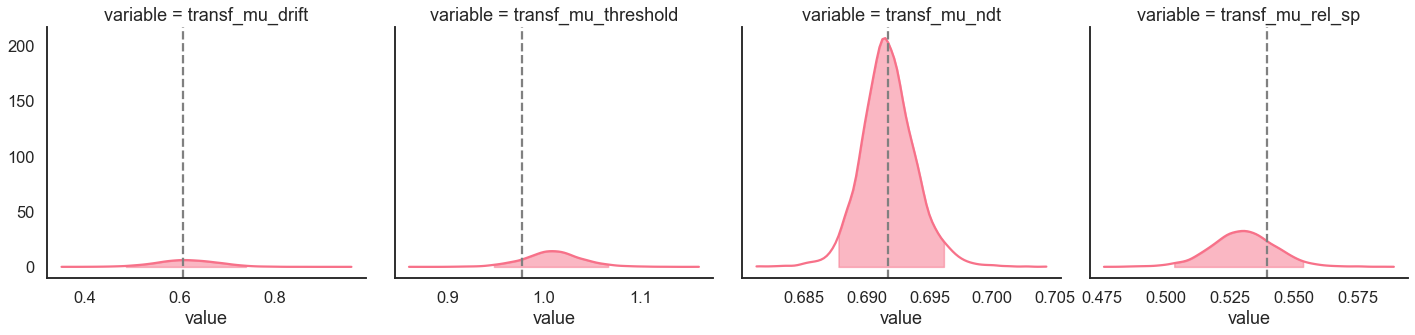
Here we plot the estimated posterior distributions against the generating parameters, to see whether the model parameters are recovering well:
[13]:
g = model_fit.plot_posteriors(height=5, show_intervals='HDI')

for i, ax in enumerate(g.axes.flatten()):
    ax.axvline(data[['drift', 'threshold', 'ndt', 'rel_sp']].mean().values[i], color='grey', linestyle='--')